This blog post revisits a small-scale study that I conducted in 2019, which asked “Why should technicians in creative arts HE be drawn into teaching”? Available here: https://intellectdiscover.com/content/journals/10.1386/adch_00007_1. The central aim of the research was to explore whether gaining Fellowship of the Higher Education Academy (HEA) was a worthwhile activity for technicians.
I conducted the study while studying for an MA in Creative Education and working as a Technical Services Manager. My motivation for completing the research was that I led a relatively large team and had been incentivising and advocating for Fellowship based on my own positive experiences (I had gained FHEA early in my career, and at the time of the research had recently been recognised as an SFHEA). The research afforded me the time and structure to learn from others about their experiences of Fellowship and to pause, sense-check, and consider whether I should continue to endorse Fellowships for my team for their benefit (rather than for the institution) while also contributing new under researched perspectives on the live sector debates concerning whether these forms of professional recognition are superficial optics, as some suggest, or have credible impact, as others claim.
My research drew upon interviews with creative arts technicians who had gained Fellowship (FHEA), exploring their motivations for applying, their experiences of writing their applications, and the effect that FHEA has on their practice, professional relationships, and overall experience of HE. Mindful that academic journals aren’t always the most accessible or popular formats, I also wrote a blog for AdvanceHE, here: https://www.advance-he.ac.uk/news-and-views/Technicians-Fellowship-as-a-stepping-stone-to-academia.
At the time, participants generally described experiencing value in both the process and the outcome, and I concluded in my paper that Fellowships provide a worthwhile introduction to learning and teaching for technical staff and an effective vehicle for continuing professional pedagogical development through remaining in good standing.
In 2018, when I completed the interviews, technician roles were becoming more teaching and learning focused, but neither rewards nor recognition were keeping pace. The qualities that kept the provision afloat, passion, enthusiasm, and habitual overperformance were burning out over time, turning into resentment, disillusionment, declining morale and high staff turnover. The lack of recognition served to widen the gap between ‘us’ (technicians) and ‘them’ (academics) as the most highly motivated and capable technicians were intrinsically driven to operate at levels well above their pay grade, developing and delivering significant proportions of the curriculum, but being systematically and structurally excluded from learning and teaching strategies, pedagogic development, and quality mechanisms.
In this backdrop, Fellowship provided an external framework and psychologically safe space for these staff to be formally recognised for their effort, abilities, and practice within a highly respected global community. It also provided a valuable space for technicians to openly discuss their teaching and support of learning alongside academic staff (often from different disciplines), and this was found to be effective at building positive, respectful, collaborative relationships between academics and technicians at a local level – which, as my forthcoming book argues, is where optimal educational practice thrives. Though, it did also highlight a new schism between pedagogically orientated techs (those with, or studying for teaching and learning qualifications) and other colleagues who perceived these traits to be crossing a line into academic territories.
Participants reported increased self-confidence, improved self-esteem, expanded professional networks and richer engagement with academic activities. They also described being motivated to gain Fellowship to increase the likelihood of transitioning from a technical role into an academic teaching position. In terms of other benefits, I did caveat my conclusions by noting that Fellowship does not, in itself, make an individual an excellent teacher, although many excellent teachers do choose to pursue a Fellowship. Rather than seeing it as a career boost, I urged potential applicants should see it as a means to improve their confidence and practice, to enjoy the learning experiences and to do so for intrinsic reasons rather than in anticipation of external reward or recognition.
While Fellowships include ‘HEA’, this organisation no longer exists as an entity; it was subsumed in a merger with the Leadership Foundation for Higher Education and the Equality Challenge Unit to form AdvanceHE. However, Fellowships continue to thrive, with AdvanceHE reporting in January of 2025 over 200,000 fellows worldwide: https://www.advance-he.ac.uk/news-and-views/celebrating-our-communities-across-he-world.
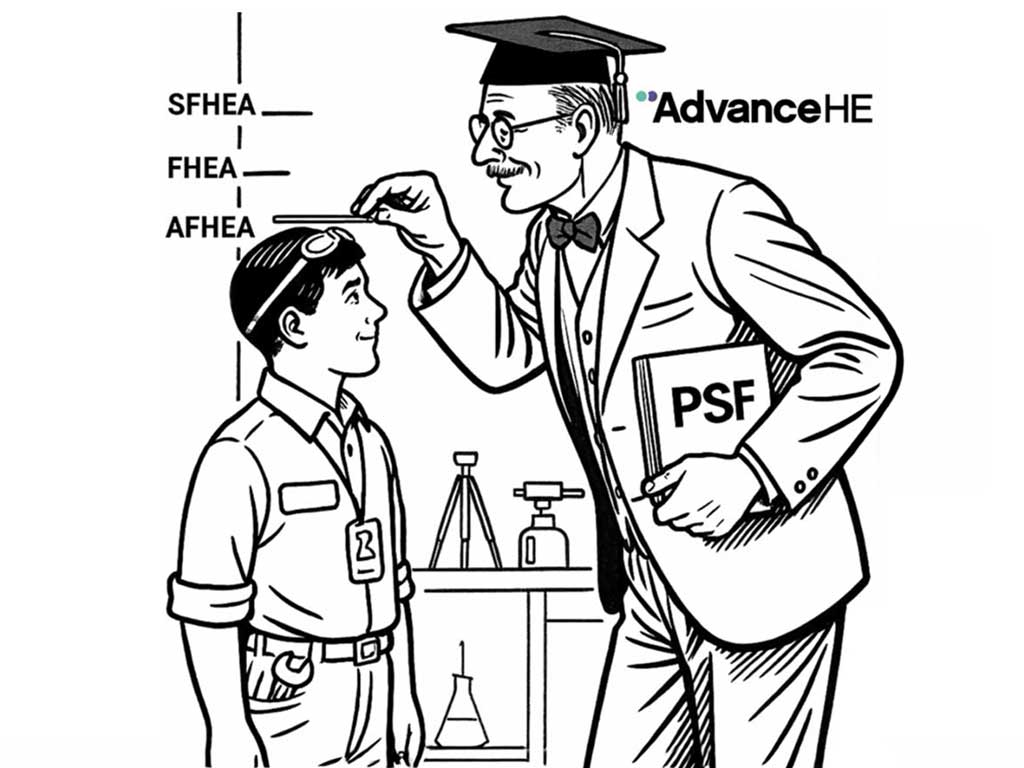
While there have been some changes to the application processes and submission requirements, the Fellowship categories remain as they were at the time of my research: Associate Fellow (AFHEA), Fellow (FHEA), Senior Fellow (SFHEA), and Principal Fellow (PFHEA). AdvanceHE describes AFHEA as the most appropriate level of recognition for technicians. However, my article and subsequent experiences have demonstrated that it’s perfectly possible for technicians with teaching responsibilities to gain FHEA, and that technical staff who can demonstrate leadership and impact beyond their own delivery are increasingly being recognised at SFHEA. I gained SFHEA myself as a Technical Services Manager, and the remit has expanded since, I reflect on this in a previous blog post about how the role of Technical Services Manager has evolved: https://www.timsavageconsulting.co.uk/reflections-upon-the-changing-role-of-technical-managers-in-he/
While my own focus is arts based, case studies published this month by the National Technician Development Centre (2025), here: https://www.ntdc.ac.uk/news-and-events/news/etp-case-studies into the experience of educational technical professionals (ETPs), describe Fellowship for contemporary technicians as crucial, providing “the formal language and the ‘piece of paper’ that validated my educational practice alongside my technical competence” (Bill Surradge – Edinburgh Napier University) with another describing how the experience was critical in formally shaping my professional identity and embedding a practice of critical reflection (Michael Bayliss – University of Liverpool). So, all good then, what’s not to like?
What’s changed since 2019?
This is a short blog/opinion piece, and I can’t do justice to six years of unprecedented sector chaos in a few paragraphs. However, it is sufficient to say that, within a relatively short period of time, HE has been transformed in response to what feels like a tidal wave of combined pressures and challenges from almost every angle. Yet, in a strange and largely unrecognised twist (or ‘technical turn’ – as I refer to it in my writing), the macro influences buffeting the sector have elevated the profiles and practices of technicians more kindly than many other groups in HE. There is clear recognition from the UK government and those leading our universities that technical learning must be at the forefront of future workforce design and learning and teaching strategies, I reflect on this in a post here:https://www.linkedin.com/posts/dr-tim-savage-pfhea-b968782b_higher-education-consulting-services-pa-activity-7394444497784303616-_S1R?utm_source=share&utm_medium=member_desktop&rcm=ACoAAAZbg6IBl-9AP3wGw-BmopG_SAtGrQW1h_U and I will unpack it further in a future blog post.
A summary appropriate for the here and now is that conditions in HE are increasingly favourable towards skills and the pedagogies of technicians, predominantly for reasons of economy and efficiency (technical teaching is cheaper), and quality and vocational application (technical teaching is most effectively delivered by those with technical skills). If VCs were granted three wishes right now, I suspect many would choose value for money, high quality teaching, and positive graduate outcomes.
This is because the ground is shifting under universities. The government is reorganising the skills landscape and challenging providers to prove real-world value: Skills England signals a system geared to workforce capability; Jisc’s review of the HESA staff record is pushing institutions to name, define, and count technicians properly; and TEF consultations increasingly emphasise practical and technical contributions. UKRI are expanding the People, Culture and Environment element of REF2029 to be inclusive of technician contributions, which, taken together, make the technical workforce more visible and mission-critical than ever before, and strategically consequential, rather than invisible background labour as they were when I began my career in HE.
Contemporaneously, the economics are unforgiving. Frozen fees, post-pandemic finances, deficits, mergers, the taps being turned off for international students, OfS spotlight on lucrative sub-contracting courses, increased cost pressures, and value-for-money debates are forcing leaders to redesign operating models. The growth of degree apprenticeships, modular routes, and other work-integrated provision is shifting from traditional knowledge and scholarship domains to a skills-based business model. In this new world, technicians have become important educators, delivering practice-based learning at scale. As they continue to gain HESA recognised teaching qualifications via AdvanceHE fellowships the previously clear distinctions between academic and technical teaching of practice fades to nothing, particularly in the arts. This shift has been foreseen for decades; for example, the Dearing Report of 1997 noted that the “distinctions between academic and non-academic staff were becoming increasingly blurred”. Fast forward to 2022, the Research England funded TALENT Commission report, here: https://www.mitalent.ac.uk/theTALENTCommission found “there are now two extremes of teaching technicians: one primarily supporting the teaching activities of academic staff; the other effectively performing the duties of academic teaching staff, despite not being recognised or remunerated as such.”
The point about not being recognised is particularly salient in this blog post about professional recognition. Except, technicians are being recognised (by AdvanceHE). While the current HESA metrics aren’t sufficiently granular to extrapolate clear figures (yet – but it’s coming), in areas such as the creative arts, academic staff had the second lowest percentage of qualified teachers (49%) in the sector (Physical Sciences were the lowest with 47%). Technicians working in the creative arts have the highest percentage of teaching qualifications among technicians in other disciplines.
A study of technical teaching by Wragg et al (2023), here: https://doi.org/10.1080/0309877X.2023.2231380 that drew on 1766 responses from technicians working across the full disciplinary spectrum found 95% of creative arts technicians who responded described being involved in teaching (compared with the sector average of 81%) and 41% of creative arts technicians described designing and/or co-designing curricula (more than twice the number of technicians working in other fields). Responses also described significant involvement in formative feedback and summative assessment. The authors surmised “these technicians are performing duties well beyond ‘supporting’ teaching and are in fact delivering duties more traditionally associated with academic teaching staff” (Wragg et al., 2023:7). They also conclude that while the arts are at the vanguard of this shift, their study illustrates the blurred pedagogic responsibilities of technicians occurring and/or being perceived across different discipline areas and throughout different types of HE institutions.
Culture and expectations are shifting, too. A more diverse student and staff body demands inclusive, pastoral, identity-building teaching in studios, labs and workshops. The rise of “third-space” professionals legitimises hybrid roles, and additional studies have examined a raft of non-academic staff gaining Fellowship, for example, Ball and Ribchester (2025), here: https://journal.aldinhe.ac.uk/index.php/jldhe/article/view/1232 found enhanced voice, confidence, reflection, and identity resulting from non-academics successfully completing the fellowship process. However, translating these benefits into practice relies heavily on inclusive structures that encourage, provide role models, and support making the language and expectations accessible. Their findings indicate professional recognition schemes grounded in tailored guidance for support staff contexts offer significant untapped potential.
The Technician Commitment has, and continues to expand globally, developing and sharing UK best practices while keeping pressure on visibility, recognition, career development, and sustainability. The UK Institute for Technical Skills and Strategy (UK ITSS) provides thought leadership, research, and policy guidance, while new interpretations of technical roles, including Research Technical Professionals (RTPs) and Educational Technical Professionals (ETPs), are emerging. This moves the sector forward from using technicians within a deficit model; as “a substitute for insufficient tutoring”, cautioned by Cleary (2024), here: https://intellectdiscover.com/content/journals/10.1386/adch_00087_1, or “cheap labour” to replace under-resourced academic teaching communities (Wragg et al., 2023).
Meanwhile, technology keeps redrawing the map. Post-COVID hybrid infrastructure, rapid adoption of AI, and the spread of XR in creative disciplines expand what (and where) learning looks like, who designs it, and for what purpose. Technical teams are at the front of this shift; the PSF and Fellowship offers the language and standards to evidence impact across planning, delivery, assessment, environments and continuing professional development.
AdvanceHE has seen a significant leadership change recently, with the appointment of a new CEO, Alistair Jarvis CBE, who recently authored a blog for the Association of Heads of University Administration, here: https://www.ahua.ac.uk/opinion-post/tackling-strategic-issues-facing-higher-education-institutions/ in which he talks about tackling the strategic issues facing Higher Education Institutions (HEIs). He questions whether the blend of academic model and student support structures is fit for current needs (which is complex for technicians, as they often sit between the two – but have a massive impact on student learning and experiences). He also notes that the current challenges require universities to enhance leadership capabilities at all levels and manage transformation and change, across and within academics, professional services, and leadership teams. Collaboration between these elements will be key, and recognition (professional and socio-cultural) will be an important element of this.
So, things in the sector have changed quite a lot, and my own perspective has shifted too. Since publishing my fellowship article, I have also been a mentor, assessor, and advisor to many (academic and non-academic) who engage with the Fellowship. I gained the confidence to complete a PhD that explored how creative technicians teach and support learning at a national level. I worked on the TALENT Commission to develop my knowledge and understanding of technicians working in the non-arts sector and influence policy. Another important milestone in the context of this blog was gaining PFHEA. I choose to include my PFHEA post-nominals in my LinkedIn profile. I do it for two main reasons. Firstly, because I am proud to have achieved this level of recognition from within the technical stable – I never thought I would, and imposter syndrome is powerful (as Bill notes in the aforementioned NTDC report). Secondly, I hope that my visible engagement promotes that PFHEA is an attainable goal for non-academic staff. AdvanceHE used an anonymised version of my PFHEA application in their training materials as an exemplar of a non-academic application, and I’d like to think that, through my research and experiences, I’ve gained deep knowledge and understanding of technician pedagogies. I was flattered to be asked by AdvanceHE to provide feedback on the Principal Fellowship guidance for non-academic and technical staff following the revision of the PSF in 2023.
On this point, in my view, the revised PSF provides a more fit-for-purpose framework in which to recognise the pedagogies of technicians. It is more inclusive and context-aware, emphasising effectiveness, impact and the environments where practical and applied learning is supported (workshops, labs, studios), not just what happens in academic domains. It explicitly recognises the diversity of roles that teach and/or support learning, making Fellowship more accessible to technicians and professionals beyond traditional academic contracts.
Additionally, through the work of the Technician Commitment, ITSS, Gatsby, and emerging authors, the sector is beginning to build a corpus in which to contextualise and theorise the contribution of technicians to HE. In 2019, there was minimal literature in which technicians could contextualise their practice; now, there is a great deal more. Within this, I hope my research, articles and publications help to provide a deeper understanding and language of technical pedagogies, spanning from subject-centred to transformation-centred practice. Language specificity is important, providing technicians and sector stakeholders with a way to recognise, develop, and evidence technical teaching rather than relying on outdated stereotypes or job titles.
When I conducted the fieldwork for my article in 2018, the participants were hesitant to describe their teaching as ‘teaching’. The same inhibitions remain true today. This lack of personal recognition of teaching was so powerful that I titled my thesis’ teaching to the line’, referring to the undefined point at which technical teaching in the creative arts wandered into academic waters (if academic and technical teaching are different, then it should be possible to distinguish between the two). I co-wrote an article about this with Kelly Vere, here: https://journal.aldinhe.ac.uk/index.php/jldhe/article/view/1191.
Reflections
Given the multitude of changes in higher education (HE) and their impact on technical roles and teaching practices, it is evident that the sector is starting to recognise technicians as legitimate teachers. This recognition is particularly influenced by government directives emphasising the importance of skills and the promotion of technical education in policy and resources. So, returning to the question that started this blog: is it worth it?
On balance, I believe it is worth it. For its own sake, as described in my previous article, but also dispel the shibboleth that technical teaching is in some way not proper teaching or is inferior to academic teaching. The challenge in emerging from this outdated view is partially due to the systems and cultures of institutions, but it is also critical that technicians break free of their own self-limiting beliefs. Contexualising and critically reflecting upon practice in support of professional recognition (AdvanceHE) and the formal acknowledgement of the pedagogic aspect of technician roles (HESA) play important roles in this. Additionally, Fellowship can now contribute to career advancement in different ways. Opportunities are opening up for technicians who teach, and increasingly these are being formally structured via career and promotion pathways. These relatively new models set out criteria for advancement that often include some form of professional registration. So, rather than Fellowship being perceived as a route into academia, it can now be seen as an effective enabler of progress within a technical career.
For institutions, this is a strategic opportunity. Recognising technical teaching drives quality, strengthens TEF-relevant narratives, and aligns directly with Technician Commitment goals around visibility, recognition and career pathways. In a few years, the teaching qualifications of technicians will likely be included within the HESA Staff Return. When called to report on teaching excellence, in an increasingly technical skills-driven paradigm, this is an essential metric.
Leveraging this opportunity is the responsibility of institutions. AdvanceHE’s frameworks and accreditation policies already provide the necessary flexibility and structures, but it is within our universities that the stories, evidence, and mentorship must develop.
Support for Fellowship
Earlier this year, I stepped away from my role as Director of Technical Learning to establish my own consultancy and training practice. My focus is to help universities gain quality and value from their technical staff by recognising, supporting and measuring what really matters in learning and teaching.
My website www.timsavageconsulting.co.uk outlines how I can help institutions, but specifically in relation to this blog, my experience and expertise in the Fellowship for technicians is where I can add value, particularly for institutional schemes developed and delivered primarily for academic staff by focusing on the pedagogical dimension of technical practice, particularly in the creative, design, and arts-based disciplines, where technician teaching is most prevalent and sophisticated.
As the sector’s accountability frameworks evolve, so too must our understanding of who teaches, how they teach, and how that teaching is recognised. In my view, the Fellowship journey remains the most powerful pathway to make that visible and I have written a course to guide technicians through the Professional Standards Framework (PSF), helping them to map their experience to the relevant descriptors and identify evidence of their teaching and learning impact. Participants will explore case studies of successful technical Fellowship applications, learn how to frame and articulate their work in pedagogical terms, and begin drafting their own claim.
By demystifying the process, building confidence, and fostering peer support, the course empowers technicians to pursue AFHEA, FHEA, or SFHEA as part of their professional development journey. The full course description is available here: https://www.timsavageconsulting.co.uk/wp-content/uploads/2025/12/AdvanceHE-Fellowship-for-Technicians.pdf
Who is it for:
- Technicians at all career stages seeking AdvanceHE Fellowship.
- Technical managers supporting staff development.
- Learning and Teaching or OD teams looking to embed technician recognition in CPD pathways.
By the end of the course, participants will be able to:
- Understand the structure, purpose, and institutional value of the Professional Standards Framework (PSF) and AdvanceHE Fellowship;
- Identify and evidence their own contributions to student learning, teaching support, and curriculum enhancement;
- Articulate technical teaching and support activities in the language of pedagogy and the PSF dimensions;
- Begin drafting a Fellowship claim (AFHEA, FHEA, or SFHEA) with clarity and confidence;
- Recognise how Fellowship contributes to institutional KPIs, Technician Commitment, and career progression pathways.
An additional area I am eager to explore is supporting senior non-academic staff to stake claims for SFHEA and PFHEA through 1:1 mentoring (and critical friend feedback), drawing on my own Fellowship journey and assessor experience. Many in my network have ample evidence of demonstrating leadership, influence and sustained impact at these levels of Fellowship, but struggle to map against the PSF, find the pedagogical language challenging, or lack sufficient familiarity with theoretical frameworks through which to reflect and contextualise their activities.
If you are at a career stage where you are considering SFHEA or PFHEA but need some help in getting started, or finished, please do reach out.
If you would like to make a comment on this blog post, please do so on the original LinkedIn post. Available here: https://www.linkedin.com/posts/dr-tim-savage-pfhea-b968782b_advancehe-for-technicians-is-the-juice-worth-activity-7404159846666747904-_T6K?utm_source=share&utm_medium=member_desktop&rcm=ACoAAAZbg6IBl-9AP3wGw-BmopG_SAtGrQW1h_U