Universities entrust multi-million-pound facilities, the bulk of regulated H&S risk, and significant proportions of practical teaching hours to technical teams, yet the people leading these teams rarely have authentic voice into university leadership. This blog post considers the changing role of the Technical Services Manager (TSM), drawing on creative arts perspectives, as the emerging interface between strategy/operation, cost/quality, student education/experience and argues that universities should value, develop and rethink these impactful roles.
I’ve spent the last twenty years or so researching how technicians teach and support learning (in theory) while also leading and managing high-performing technical teams (in practice). I have seen many changes over this time, as the technician job family has evolved almost beyond recognition and is increasingly blurring its boundaries with academia. This isn’t always recognised inside universities in meaningful ways, but at a sector level, the Technician Commitment and the UK Institute for Technical Skills and Strategy (UKITSS) have led numerous studies and policy updates that have documented and explored these changes. One such initiative was the Research England funded TALENT Commission in 2022, accessible here: https://itss.org.uk/wp-content/uploads/2024/12/The-TALENT-Commission-Report.pdf
I was a commissioner on TALENT, and our report estimated that between 30-50,000 technicians were working in UK universities. If we take the low end of that scale as a conservative base, and triangulate typical spans of control with the number of providers with sizeable technical operations, it’s reasonable to suggest that roughly 2–4% of them (about 600–1,200 people) are likely to be in senior technical management roles with titles such as Head of Technical Services/Operations or Director. These are critically important roles that sit between institutional leadership teams and the coal face of practical and skills-based learning, yet virtually no attention has been given to what these managers do or how their roles have transformed in recent years.
To consider this, it’s helpful to consider the changing dynamics and deliverables of the teams they oversee. As part of my PhD, which charted the learning and teaching contribution of creative arts technicians, I conducted a 5-year desktop survey of all creative arts vacancies advertised in the UK (via jobs.ac.uk) to chart changes to the technician workforce at the sector level. I subscribed to weekly email alerts with search parameters of ‘technician’, ‘creative arts’, and ‘United Kingdom.’ This yielded thousands of advertisements detailing the qualifications, skills, experiences, personal qualities, salaries, and teaching duties expected of creative arts technicians. In terms of nomenclature, ‘Technician’ was the most prevalent role title (42%), the second most frequently advertised role title was ‘Technical Demonstrator’ (18%), followed by ‘Technical Instructor’ (11%), ‘Technician Tutor’ (4%) and ‘Teaching Technician’ (1%).
The recruitment materials provided rich and detailed information about the duties, level and types of teaching required from applicants set out in the words of their potential employers. Most vacancies required an undergraduate degree as a minimum standard, with post-graduate qualifications preferred. Many also stipulated a requirement for a teaching qualification or willingness to achieve one. Some stated a requirement for ‘industry-standard’ knowledge and experience; others requested that applications be accompanied by a portfolio of key pieces of creative work to showcase technical, creative, and aesthetic abilities. The language used to describe applicants’ attributes and personal qualities were expansive examples included “a passion for all that an art school can do” (Cardiff Metropolitan University) “inspirational in their approach to delivery” (Arts University Bournemouth), “Inspirational, dynamic approach to studio and workshop teaching” (Nottingham Trent, 2020), and “enthusiastic about ‘student-centred pedagogy” (Bournemouth University, 2019). Many roles were described as collaborators and co-educators with academic teams, framed as enabling and supporting the curriculum. Some were responsible for the practical elements of student learning; others contributed to summative assessment and providing written feedback. Several roles also included a responsibility for contributing to the development of new courses and reviewing existing provision, stipulating a requirement to “work with the academic staff on the design and delivery of course content, including the design and preparation of learning materials, and contributing to the discussion and planning of the curriculum” (University of the West of England).
This is quite the change from the technician job description for the role I was appointed to when I joined HE in 2000. I became a senior technician in 2002, before being appointed to manage my first technical team in 2005. The management brief was clear and straightforward: to keep the equipment running and accessible, maintain the spaces, make sure people were safe, support the academics, and deliver inductions and practical demonstrations of equipment and process (usually, to free up academic time). The qualifications, skills, experience and personal qualities required today are a far cry from the team I managed twenty years ago.
Fast forward to today, and the role could not be more different. This blog post contemplates how this shift in has impacted technical leadership roles and offers a simple outline of what a modern Technical Services Manager (TSM) does. I conceptualise the deliverables of contemporary technical teams as ‘enabling, supporting, and delivering’ university objectives, which, in my experience, have been teaching and learning-focused rather than research-focused. I describe the pedagogic elements of ESD framework in my contribution to this book: https://www.amazon.co.uk/Technicians-Higher-Education-Research-Contributions/dp/1032282851
My forthcoming book explains this framework in greater detail, and uses it to explore theories of learning and teaching grounded in empirical research spoken through the voices of technicians working throughout the UK. In brief, the ESD framework encapsulates the broad deliverables of a contemporary technical team, and I have employed it is an effective workforce planning model:
- ‘Enabling’ relates to the management of specialist facilities, maintenance, and equipment, people, systems, health and safety, financial, admin, stores, shops, print bureaus, and events.
- ‘Supporting’ describes the provision of proactive and reactive support for learners and teachers.
- ‘Delivering’ Teaching (inc. prep) inductions, demonstrations, tutorials, structured delivery hours, sign-ups, and events (e.g., applicant days, open days, freshers’ weeks, symposium, electives).
A simplistic reflection on the changes of management roles is that responsibility for the quality, sophistication and volume of technical delivery has increased to the point that teaching and supporting learning is the primary duty of many technicians. In the arts specifically, and many other practical disciplines, technicians are increasingly education-focused; making and prototyping are core to learning; and the technologies they steward now shape the creativity, ideas, and pedagogy, not merely the other way round. In terms of their positioning, TSMs can find themselves straddling the middle leadership space between academic and professional services, accountable to both, but not truly belonging to either.
What the job was vs. what it is now
In my TSM role 20+ years ago I was responsible for managing assets, maintenance, health & safety, scheduling, supporting academic delivery, and relatively light demonstration work. My contemporaries maintain all of the above, plus stewardship of inclusive learning environments, digital ecosystems, technical teaching oversight, workforce capability and progression, estates and IT brokering, procurement and sustainability, compliance, quality assurance, and the interpretation of institutional policy into operations, across campuses, disciplines and course teams. TSMs operate at the interface between policy and practice; academic aspiration and technical reality. This is a major part of the role, made particularly challenging in recent years as the resource envelope in HE has been squeezed, while contemporaneously the value of skills has become elevated over scholarship, combined with expectations for immaculate ‘sector-leading’ and ‘industry-standard’ facilities and the technical teaching and support to use them.
Every TSM day is different, and the influence and scope of contemporary these roles can extend to academic, professional services, or, indeed, the entire institution. The portfolio spans a vast array of activities, with teaching and learning at the helm, but also including finance and budgeting, from capex and equipment lifecycle planning and procurement; Health & Safety, including CoSHH, PUWER, lifting operations, LEV, responsibility for daily responses (first aid, fire warden, evac chair operation), informing PEEPs, and the full universe of logs, audits, and inspections; planning and tracking teaching hours; a vast range of HR responsibilities including recruitment, case management, wellbeing and EDI; learning environment design, equipment specification, overseeing industry-standard workflows and accessibility; VLE presence, digital learning assets, booking and asset systems, GDPR and data integrity; counter services such as loans, AV, shops and stores, with attention to customer service and stock; business cases, capital investment planning; asset management and record keeping; institutional citizenship through committees, quality assurance and enhancement, supporting student recruitment activities; project and change management across campuses and franchises; and full compliance through external inspections, internal audit and policy implementation.
While reflecting on how best to communicate this in the context of management, it occurred to me that relevant classifications began with the letter P!
The Five Ps of modern technical leadership
The “Five Ps” can be a useful way to describe the portfolio concerns of the modern TSM.
1) People
The most important, challenging, and rewarding element of the TSM role is managing people, teams and relationships (the activities of those they manage, and the expectations of those they don’t). The technician workforce is a rich, diverse and complex ensemble; indeed, HESA data confirms that the proportion of support staff who declare a disability is higher among technicians than among any other professionals or support staff. As leads, TSMs are responsible for all aspects of people management, including recruitment, selection, onboarding, mentoring, coaching, development, progression, talent management, succession planning, and career pathways. At the same time, prioritising collective and individual professional development that balances compliance, safety, pedagogy, and new technologies and role modelling, while facilitating HR operations and complex casework.
2) Performance
The modern technical team is subject to ambiguous metrics and implied performance indicators that span compliance, access, student feedback, academic perceptions, VFM, H&S, utilisation, as well as NSS, TEF, and GOS. Sometimes, in a no-win paradox, the credit for high performance can be attributed to other job families, while accountability for less desirable outcomes falls to the technicians and their managers.
3) Productivity
At a time when student experience (linked to NSS, league tables, course quality, reputation, recruitment, funding) is paramount, expectations for access to resources is at an all-time high, while budgets are reducing in real terms. The challenge, therefore, is how to convert specialist facilities and staff time into the maximum amount of meaningful, safe, inclusive learning. This requires TSMs to work collaborate and negotiate with stakeholders, modelling capacity, access and resources across workshops, studios, labs, print rooms and maker spaces; building timetables and tracking teaching hours for technical staff, including induction loads, self-directed learning, and open-access provision; aligning counter services and front-of-house functions, including equipment loans, AV support, shops and stores, to peaks and deadlines; managing assets and downtime through preventive maintenance, calibration and compliance while maximising uptime.
4) Politics (internal)
TSMs live in the ‘third space’. They must balance demands and broker between academic priorities and professional services constraints without becoming cannon fodder for either. They walk a middle line, sometimes between a rock and a hard place. They are accountable for vertical alignment, ensuring alignment with institutional policies and procedures, while sometimes being labelled as ‘blockers’ for doing so by those who are less accountable for breaching them. Their perspectives can be lost or diluted when they are not present on senior committees. They also work horizontally across disciplines and sites, with a helicopter view of practice, equity and parity of experiences, while academics (understandably) are more likely to focus vertically on their own course or school. This can highlight operational and ideological tensions. From my experience, if not managed well, everyone supports interdisciplinary working when their students gain access to new experiences and facilities, but the advocacy evaporates when another group of learners impacts upon their facilities or technician time. These are the kinds of emotive territorial tangles where TSMs deploy diplomacy between academic teams, students, professional services and their own teams.
5) Policy
Through their close connection to the learning and teaching in activities in studios, labs and workshops, many TSMs are uniquely placed to contribute and critique policy and procedure, particularly in relation to the learning environments and facilities. While most universities include TSM staff on matters of H&S, these staff can offer valuable insight and contribution across the full range of university activities, most obviously within professional services agendas (finance, estates, IT, sustainability, enterprise), but also through academic and quality committees, policies, and procedures. While the inclusion of the technician voice in academic policy, governance and new course planning may raise a few eyebrows, when the scale of technical delivery is brought into focus (up to 70% of core hours were delivered by technicians in some courses I’ve worked with), excluding the primary teaching team from the quality assurance and enhancement seems short sighted.
Technicians often become early adopters who stabilise workflows and develop what Shulman calls ‘pedagogical content knowledge’, which involves blending knowledge of the technology itself with how it should be taught. This is particularly salient in new disciplines and media, within a generation, the creative arts portfolio has expanded from analogue crafts (photo, animation, textiles, ceramics, metals, print, 3D) to a blend of those, new sub-disciplines, plus digital fabrication, computational design, immersive media, AI-assisted pipelines, bio materials, and creative coding. There is no long-standing knowledge base for much of this, and technicians and their managers are often at the vanguard of these developing media and practices.
Why universities need a strategic technical lead
Few technical leaders report directly to senior leadership or have an unfiltered voice in strategic forums. A TALENT, UKRI funded report sets this out in detail: https://itss.org.uk/wp-content/uploads/2024/11/Strategic_Technical_Leadership_Report.pdf
When the representation of complex technical issues in the studios and workshops are vicariously interpreted and relayed by well-meaning others, the messaging is distorted, priorities are lost, actual quality suffers, and institutional deliverables suffer. The solution is simple: appoint a strategic technical lead (e.g., Director/Head of Technical Learning/Services), position this role alongside other academic-adjacent leaders, and hold it accountable for strategy, performance, people, and risk across the technical domain. Where that happens, teaching quality, efficiency and staff morale improve because the people who actually run the environments are part of the decision-making.
Careers, recognition and representation
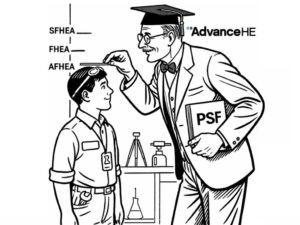
In my experience, there is a healthy pipeline of motivated people interested in TSM roles, but the applicants are often at a career stage where they are better suited to senior tech roles (they are really good technicians seeking advancement, but not yet leaders or managers). Working as a technician does not build experience or capability in the critical 5 ‘P’s I’ve discussed here. These can be gained organically over time, and there are sector models for development: for example, the Hershall programme to promote the participation of Women in technical leadership roles, here: https://itss.org.uk/technical-leadership-programmes/herschel-programme/ and the Executive Leadership course from the ITSS, here: https://itss.org.uk/technical-leadership-programmes/ with the support of communities like the Technician Commitment; and cross-institutional networks. AdvanceHE also offer professional recognition that aligns with both technicians (AFHEA/FHEA) and managers (SFHEA/PFHEA). My next blog post will reflect on the value of AdvanceHE fellowship to technicians and their managers, updating an article I wrote in 2019 here: https://intellectdiscover.com/content/journals/10.1386/adch_00007_1. I know many TSMs, Heads/Directors of Technical Services that operate at a level that merits Senior or Principal Fellowship of AdvanceHE, but lack the confidence, starting point, or theoretical frameworks to write a successful application. As technical teams are becoming increasingly pedagogically focused and included with teaching excellence discourses, their managers must be developed in accordance with these principles, priorities, pedagogies, and the other 5 Ps!
Closing thoughts
I’ve worked in technical management for two decades. It’s the best apprenticeship for executive leadership I can imagine: you learn to translate strategy into operation and timetables, and to align budgets to pedagogy, theory, and practice, coach teams, to balance risk with access, to think institution-wide while directly connecting with student learning and experience. In other words, it’s an ideal training ground for the multifaceted complexity of contemporary HE. These critical staff should be developed, supported, and integrated with senior leadership.
This post has focussed upon the creative arts, which was identified by the TALENT as an outlier in terms of the scale and sophistication of technical teaching, but the commission also described how these practices are a foreshadowing of things to come in the broader HE sector.
If you’re new, existing or aspiring in a TSM role and want help with:
- Shaping your portfolio around the Five Ps;
- Navigating the third space between academic and professional services;
- Building evidence for a SFHEA/PFHEA application;
- Developing technical teaching and QA for your environments;
- Preparing business cases for kit, space and people;
- Or simply becoming more confident as a technical leader
…get in touch. I coach, mentor and support technical leaders and teams in the UK and internationally.
If you wish to comment on this blog post, please add your thoughts to the original LinkedIn thread. Available here: https://www.linkedin.com/posts/dr-tim-savage-pfhea-b968782b_reflections-upon-the-changing-role-of-technical-activity-7393959254358982656-Z8wW?utm_source=share&utm_medium=member_desktop&rcm=ACoAAAZbg6IBl-9AP3wGw-BmopG_SAtGrQW1h_U