I wrote this article for EuroSoTL. To view the published version, click here: https://eurosotl.org/?p=2521
“You don’t teach, you demonstrate.” That was how my line manager explained the difference between the lessons I delivered as a photography technician and those of my academic colleagues. But this didn’t make sense to me. I taught students in the same studios, using the same equipment and similar approaches.
Background to the book
Later, as a technical manager and then Director of Technical Learning at a leading UK creative arts university, I found that generic descriptions and imprecise language affected how teaching was recognised, resourced, and developed. The recognition of teaching quality, it seemed, depended on a teacher’s contractual status rather than their pedagogical practice.
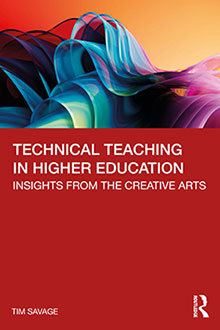
These experiences prompted the research behind my recent book, Technical Teaching in Higher Education: Insights from the Creative Arts. I wanted to understand what technicians believed they taught, how they approached teaching, and why they worked in the ways they did.
The book examines changing relationships between practice, theory, and academic research in creative arts higher education. Within this context, I explore how technicians have expanded their responsibilities for teaching and supporting practical learning.
What is the book about?
While the book focuses on technicians, their changing roles can also be understood through Celia Whitchurch’s concept of a ‘Third Space’, in which academic and professional boundaries blur and professional identities evolve. Comparable questions arise for roles such as educational developers, clinical educators, laboratory specialists, learning technologists, workplace mentors, careers teams, and the many others who support student education, experiences, and outcomes.
Within the creative arts, I have observed this transformation in technicians’ increasingly sophisticated teaching responsibilities. They help students build the skills and mindsets to become confident practitioners. Yet many institutions still assume that only academics teach, while professional, technical, and operational staff simply create the conditions for them to do so. This polarisation creates a paradox in which universities simultaneously rely upon technician-led teaching while sustaining structures, policies and cultures that fail to recognise it.
My doctoral research used phenomenography to explore how arts technicians conceived of their pedagogies. It identified five approaches: Demonstrator, Instructor, Consultant, Collaborator, and Transformer. Each describes a different way of understanding and approaching teaching, and the technician participants drew on several of these approaches depending on the learner and the context.
In brief, Demonstrators introduce safe and competent practice; Instructors help students develop and apply skills. Consultants work through problems with learners, while Collaborators explore possibilities alongside them, sometimes without either knowing where the process will lead. Transformers support changes in how students understand their practice and themselves as practitioners. These approaches span a spectrum from teacher-centred content delivery to student-centred, transformative learning, broadly comparable with the range identified in research on academics’ conceptions of teaching.
So, what might this mean for the Scholarship of Teaching and Learning?
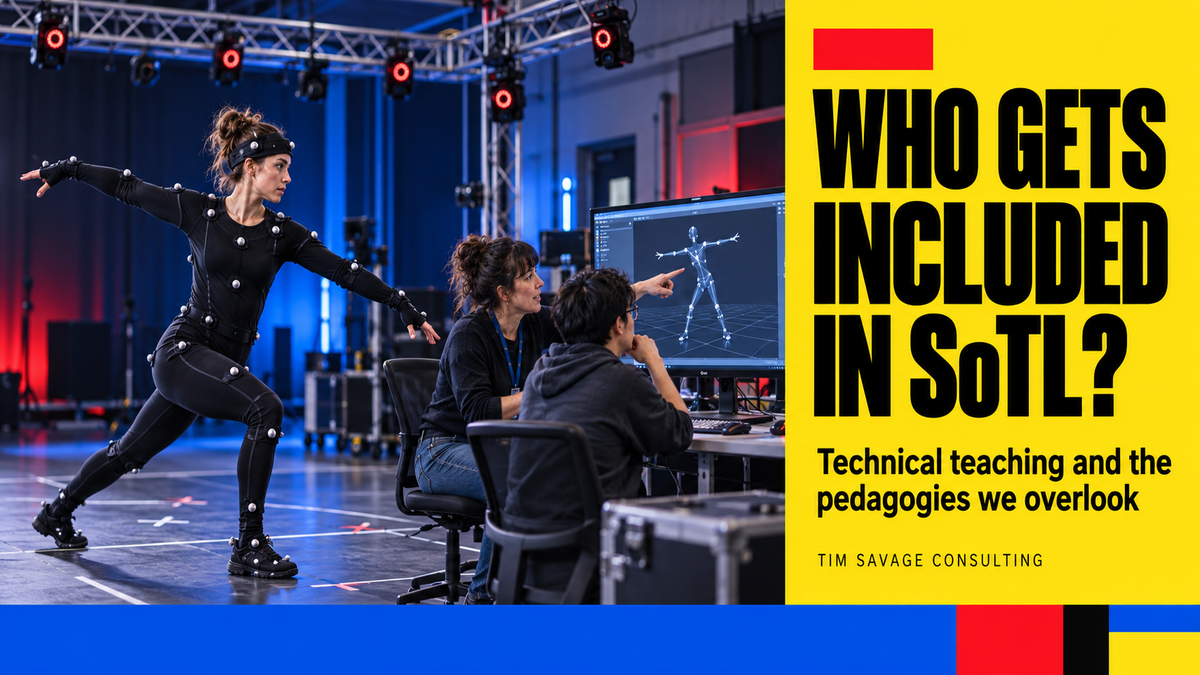
In my experience, much of the SoTL literature is written by academics, about academic activities, for academic audiences. While this is understandable, it also means that established corpora, discourses, and theoretical frameworks are not fully representative of all staff who teach and support learning. In a sector that purports to value challenge, diversity, and inclusion, this gap in recognition and understanding of non-academic pedagogies needs attention and exploration.
Bringing the under-heard voices of professional and technical colleagues into these conversations could change the questions we ask and the explanations we develop. A technician working alongside a student during self-directed study may see how a failed process prompts a new idea, how practical judgement develops through experimentation, or how confidence grows through informal feedback. Studying these encounters could help us understand how skills, confidence, and practical judgement develop and how to improve teaching during self-directed study.
The opportunity therefore extends beyond recognising additional groups as educators. Their experiences could inform how we understand relationships between theory and practice, expertise and teaching, and support and independence. Involving technical and professional colleagues in framing research questions, interpreting evidence, and developing explanations would bring their perspectives into the scholarship itself. My research offers one starting point, but colleagues in other professional roles will bring different insights and challenge some of its assumptions.
The titles and boundaries of these roles vary across countries and institutions, but this offers scope for comparison and mutual learning. Whose educational expertise remains under-represented in our own SoTL communities? What might we understand differently if those colleagues helped shape our enquiries? And what would need to change to make their participation possible?
If you wish to comment on this blog post, please add your thoughts to the original LinkedIn thread. Available here: https://www.linkedin.com/posts/dr-tim-savage-pfhea-b968782b_who-gets-included-in-sotl-technical-teaching-activity-7506633920390680577-yPf-?utm_source=share&utm_medium=member_desktop&rcm=ACoAAAZbg6IBl-9AP3wGw-BmopG_SAtGrQW1h_U