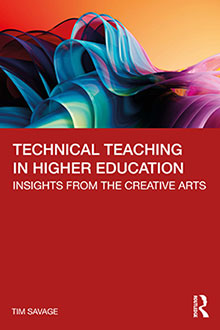
As the world turns its attention to the impending FIFA World Cup, my blog this month piggybacks the mood by offering a fresh take (via a footballing analogy) on the shifting roles, responsibilities, and relationships between technical and academic staff in HE (from a creative arts perspective). I discuss these dynamics and what I call a ‘technical turn’ (in which academic and technical roles have transformed, partly in response to each other, and in the context of external factors) in greater detail in my new book: Technical Teaching in Higher Education: Insights from the Creative Arts.
This analogy begins just after the 1998 World Cup (England lost on penalties to Argentina, in the quarter-finals), when the technician roles at my institution (the Surrey Institute of Art and Design – SIAD) were upgraded (in both responsibility and pay) to include delivering ‘demonstrations’.
The decision to upgrade the technician role at SIAD wasn’t made in isolation; it reflected the national trend, made visible by the publication of the National Committee of Inquiry into Higher Education (1997), better known as The Dearing Report, after its Chair, Sir Ronald Dearing. Dearing acknowledged ‘There is a wide range of non-academic staff employed in HE and, for some of them, the distinctions from academic staff are becoming increasingly blurred’. This was especially evident in creative arts universities, where technicians were at the vanguard of the blurring, where in some disciplines ‘technical demonstrations’ could be indistinguishable from academic practice-based teaching.
This shouldn’t be all that surprising, because, since their inception, teaching in art schools has always been focused on the practical (creating artworks and artefacts rather than talking about them), but following the Coldstream Reports of the 1960s, the art and design curriculum was formally expanded to include additional theory, history, and context, which, for some, espoused the cerebral rather than the practical. The revised mission was reflected in the workforce, as more theorists, lecturers, professors, and researchers joined the teaching ranks. This would accelerate further as the former ‘Institutes of art’ became ‘universities of art’. The first of which was the Royal College of Art being granted a Royal Charter in 1967, and the most recent was Plymouth College of Art becoming Arts University Plymouth in 2022. The academisation of the art schools into universities (described as an ‘Academic Turn’ by Orr and Shreeve) contributed to a sector-wide pivot from practical ‘know-how’ to scholarship and knowledge.
This phenomenon, where non-universities (polytechnics, colleges, or professional/vocational institutions) aspire to act like universities by emulating their practices, often by adopting theoretical approaches, prioritising research over teaching, and reducing practical/technical instruction, is described as ‘Academic drift’. As the curriculum, staffing base, and epistemological emphases changed, the traditional art schools found themselves ‘drifting’ away from their original purpose of providing labour pipelines for local manufacturing industries. I accept that the caricature I have painted so far is a highly generalised oversimplification, but it serves to illustrate the broad trends and sets the scene for the rest of this post… and I will get to the football bit soon.
The emergence and proliferation of technical demonstrations at the turn of the millennium and early noughties can be attributed to technical staff filling the ‘gap’ left behind, as academic roles ‘turned’ and ‘drifted’. Initially, these demonstrations were basic explanations of how to use equipment or processes safely and competently. They were undertaken by the newly upgraded technicians simply to save valuable academic time. The logic being that once the basics were instilled, students would be handed over to the academic master practitioner/teachers. However, as creative technologies evolved, technical demonstrations became more sophisticated, and in many disciplines, technicians became the master practitioners/teachers that students required to advance their practice. This was clear to me at SIAD, but it was a perspective that many of the academics I encountered resisted. Ellen Lupton captured this in her US study, finding ‘Technical skills are what many of our students want. Teachers would often rather spend a five-hour critique talking about ‘ideas,’ while their students are hungry for technical knowledge.’
At the time, I recall a senior leader at SIAD proclaiming that technicians needed to “know their place” regarding learning and teaching, but without specifying where or what that place might be. These same tensions were playing out in the literature at the time, as academic teams were increasingly aware of, and generally disapproving of, a new tribe of non-academic interlopers interfering with pedagogies. Ian Dobson described a ‘them and us’ attitude, characterised by ‘fear and loathing’ between professional and academic staff. Other authors also explored this new emergent territory that sat between academic/non-academic domains. The most well-known of which is Celia Whitchurch, whose concept of the ‘third space’ charts the ambiguous spaces between academics and professional services as they evolved to co-exist and overlap.
I remember discussing my technician role with my line manager around this time, and trying to understand the changing roles and boundaries, and seeking to make sense of what ‘our place’ actually was. We used football as a model, agreeing that in general terms, we (the technicians) could be thought of as the groundskeepers, insofar as we generally worked behind the scenes, prepared the pitch, maintained the facilities, checked the equipment, set out the resources, managed the risk, and created the conditions in which ‘the game’ of education could take place. The players, of course, were the academics. They were the stars who stepped onto the field that we prepared for them, so that the academic activities of learning, teaching, assessment, and research could take place. We would show students how to use equipment and help them when they got stuck, but this was all fairly low-level at the time. A good pitch, we reflected, represented a job well done for the technical team. It was a tidy analogy, and for a while it broadly reflected how ‘we’, the technicians, and ‘them’, our academic colleagues and the university, tended to think about and describe our roles. For a short time, it seemed this was ‘our place’.
However, as time passed, despite the frictions and evident lack of a parity of esteem in my institution, it became increasingly recognised that technicians were engaging in teaching activities (despite not being permitted to call it teaching), and just before the 2002 World Cup (where England lost to Brazil 2-1 in the quarter-finals), a new upgraded (again) technician role was established at SIAD: Technical Tutors. This further blurred the boundaries with academic colleagues, but it also created a schism within the technicians, which persists to this day, with the latter group often seen by technicians as ‘teachers’ but commonly ‘just a technician’ in wider university cultures.
The establishment of the Technical Tutor roles (sometimes called demonstrators or instructors at other universities) undermined the groundskeeping analogy. Technicians were no longer just preparing the pitch. They are on it. Technical staff found themselves teaching, coaching, troubleshooting, adapting play in real time, developing learners, and, in some cases, influencing the tactics, refereeing, and dictating how the game should be played. Few were keeping score though, as summative assessment remained exclusively academic.
Meanwhile, as the drift continued, some academic roles, especially in practice-based settings, took on new and different responsibilities, shaped by research cultures, performative systems, elevating admin, and disaggregated workloads, with many removing themselves, or being removed from the live, material, technical realities of making. For some, such as James Elkins, writing in Why Art Cannot Be Taught, art schools of this time were prioritising teaching people to appreciate art, rather than create it, resulting in what Elkins, and many others, describe as the widespread ‘de-skilling of academia’. This deskilling occurred as ‘skills’ were increasingly prioritised by government, employers, students, and graduates, a trend that was amplified by the introduction of fees and an accompanying emphasis on value for money and vocationalism, with graduate employability becoming a new proxy for course quality.
As teachers of ‘skills’, several technicians I knew gained the confidence to apply for academic roles, but they were rarely appointed. There seemed to be an unwritten idea that technicians and academics were fundamentally different species, which the Higher Education Funding Council for England (HEFCE) captured well in their 2004 investigation of the supply, retention, roles, development and career progression of highly skilled technicians working in UK higher education. The report accepted that technicians in HE were increasingly carrying out what they called ‘quasi-teaching’ (citing the creative arts as the area where this was most prevalent), but concluded, ‘It is unlikely that a technician would be able to progress to being a pure academic’.
The HEFCE report coincided with England being knocked out of the European Championships in the quarter-finals on penalties by Portugal. Two years later, in 2006, Portugal would knock England out of the World Cup in the quarter-finals, again on penalties. In 2010, England were thrashed 4-1 by Germany in the last 16 in the World Cup.
By this time, the groundskeeping analogy wasn’t close to the lived experiences of the technicians at my university. The technicians were players, teaching alongside their academic colleagues, spatially and philosophically, but the long-standing disparity in esteem and the ‘second-class status’ of technicians persisted. I enrolled on a PgCert Learning and Teaching course to try to better understand and explore the territories between academic and technical teaching using Whitchurch’s theoretical framework. I learned a lot, my pedagogic and managerial practices improved, and I enjoyed studying alongside and learning from my academic colleagues. They learned from me, too. I didn’t feel like a different species; my teaching was ‘teaching’, not ‘quasi-teaching’, and I found that the third space could be a rich and respectful collaborative model for academic and technical staff.
2014 was an international footballing low point; England failed to get out of their World Cup group (the worst performance since 1994, when we didn’t qualify for the tournament). We had decent players, but poor tactics, inadequate leadership and management. The team, it was felt, was not a team, rather a collection of talented individuals, and in 2016, Gareth Southgate was appointed as England Manager. The same point could be made of technicians in the UK. There were pockets of good practice and good work being done by groups, for example, the National Technician Development Centre, but no clear focal point or strategy.
Just as Southgate’s new approaches galvanised England, Kelly Vere conceived the framework that would become the Technician Commitment in 2017 to provide visibility, recognition, career development, and sustainability for the technical community. Things immediately improved, both for England, who would reach the semi-finals in the next World Cup (narrowly going out to Croatia), and for the technical community, as an increasing number of institutions became signatories of the Technician Commitment, writing and publicly publishing action plans to support their technical teams, signed by vice-chancellors.
2017 introduced the Teaching Excellence Framework (TEF), which was intended to spotlight teaching and encourage excellent teaching for all students; help institutions improve the quality of their teaching by highlighting exemplary practices. Following their analysis of the 2017 provider statements, Advance HE found that just under a fifth of submissions had referenced technicians in their claims for teaching excellence.
In my recent guest blog for Advance HE, I examined the 2023 provider statements and found that over the five years between TEFs, the number of providers referencing technicians had increased to over a third. A future blog post will explore whether the inclusion of technician pedagogies results in a higher TEF rating – spoiler alert – it does.
I concluded my blog by speculating that the inclusion of technicians was likely to continue to rise in future TEFs, in part due to the TALENT Commission’s report on technicians in higher education and research, published in 2022. In the creative arts, TALENT found that technicians were especially likely to be involved in teaching activities: 95 per cent of creative-arts respondents reported involvement with teaching, compared with 75 per cent of others. They were also more than twice as likely to design curricula or lesson plans, provide formal feedback, teach groups, support learners one-to-one, and develop teaching resources and environments.
The TALENT report was published in February, and a few months later, England put in a stellar performance at the World Cup, reaching the quarter-finals before being knocked out by France (the eventual winners). However, the trajectory was positive, and in the following European Championships in 2024, England reached the final, narrowly losing to an 86th minute goal from Spain. This investment in the national team performance was mirrored in the technical community, as the TALENT Report’s recommendation to establish a new collaborative entity (The UK Institute for Technical Skills and Strategy) was funded, with a remit to ensure the long-term sustainability of UK technical skills and careers.
This brings us almost up to the present day, so I’ll revisit and update the football analogy by reflecting on a recent experience of auditing a provider’s delivery. My examination of timetabling data showed that in some instances (notably, the most materially and technologically intensive disciplines), the educational model was broadly as follows: Academics introduce the brief (talk about what students need to learn), complete tutorials (talking about the work in progress), and assess the work (feeding back on the submitted work). The technicians interpreted the curriculum, unit, and learning outcomes, planned and delivered progressively developmental lessons in studios and workshops, teaching, scaffolding, and supporting learning. In this scenario, the technicians are the players, the lecturers are the commentators, and the course leaders are the managers – deploying personnel to positions based on their effectiveness.
This is not to say this shift is a problem; the model has evolved in response to the actual (rather than assumed) student needs, which is a blend of competencies, as set out in the newly minted QAA Subject Benchmarks for Art and Design. Thinking, talking, and doing are interrelated, and commentary has value; universities need critique, interpretation, theory, contextualisation, reflection, and staff who can stand back and help students make sense of what they are doing and why. However, a problem arises when commentary becomes too detached from practice; when making, testing, failing, refining, and solving problems (the learning process) is not visible or coherent in the assessment process. If this occurs, the curriculum becomes ‘non-constructively aligned’, in which teaching activities (what is taught and how) are inconsistent with the curriculum, meaning summative assessment is based on connoisseurship of the artefact rather than on the learning required to create it.
A further issue is that university target operating models generally assume that the players are all academic staff, meaning that the contribution of technicians to learning and teaching can sit outside funding models, and quality assurance and enhancement activities. So, where does this situation leave our educational teams?
I would suggest that the answer is not to replace one hierarchy with another, nor to further polarise technicians and academics into rival teams. The point is to update the story universities tell themselves about teaching, call out intellectual snobbery where it inhibits learning, creates inefficiencies, siloed work, and division, and instead, plan and adopt more institutionally inclusive pedagogical strategies. In her recent blog for HEPI, Dame Athene Donald asked, ‘Are skills the opposite of education? This article seemed to hit a nerve with the readership, attracting a range of comments from sector heavyweights, but the one I think best captured the debate was from Martin Betts. Betts reminds us that while these high-level points can be theorised endlessly, we must be mindful of who learning is for and to ensure that educational strategies and tactics serve them best.
This is easy to say, but much harder to do, as Brian Rosburg articulates in “Whatever it is, I’m against it” Resistance to change in higher education. But it’s clear that the current HE model is broken and change is essential. Moreover, PA Consulting’s annual survey of UK Vice-Chancellors describes a sector “in crisis”, with a “broken system” and “structural deficit” at the heart of the operating model, with 93% saying that fundamental reform towards technical and skills-based learning is needed for universities to survive.
In the creative arts, the recently published Creative Industries Skills Audits, published by the Policy and Evidence Centre and Work Advance, identify that graduates require an ‘alchemy’ of skills: technical, digital, transversal, and business-critical to thrive as commercial practitioners. There is simply no place in contemporary HE for two competing educational teams to deliver these; rather, universities need a genuine and authentic ‘one-team’ philosophy.
So, how might we reach this reformed state? For Nigel Carrington (former VC of University of the Arts London and Chair of the UUK Efficiency and Transformation Taskforce), collaboration within and between universities is essential for both student experiences and institutional finances. Carrington suggests that efficiency is the easy part, whereas transformation involves deeper structural choices and new models of working together. In this space, the contributions of technicians, academics, teaching assistants, and professional services staff should be recognised as interconnected rather than as competing. Practical teaching is not treated as secondary to academic teaching, nor is theory/education cast as the enemy of practice/skills. Instead, we must acknowledge that excellent learning, positive graduate outcomes, and institutional efficiencies emerge when these elements are integrated with mutual respect and shared purpose. The challenge for the sector is not to decide which group matters more. It is to recognise who is actually on the pitch, who is influencing the game, and what is lost when institutions do not recognise, value, and develop all who teach and support learning.
So, what’s next, what’s going to happen for England under the new manager, Thomas Tuchel, in the World Cup, and the technical community as HE faces what many see as an existential crisis? Well, at the time of writing, the bookmakers have England as the third favourite (6/1) to win the tournament, with only Spain (9/2) and France (5/1) seen as more likely to lift the trophy. This seems a bit generous to me, and I am more optimistic about the future of the technical community in HE. While the HE sector is in dire straits, and there is no single solution to the complex and difficult present, eradicating expensive siloes and outdated stereotypes and replacing them with fit-for-purpose operating models, improved systems and cultures that recognise a unified (academic and technical), collaborative group of educators seems a great step towards building the high-performing teams of the future.
If you wish to comment on this blog post, please add your thoughts to the original LinkedIn thread. Available here: