Much of my work has been motivated by challenging outdated stereotypes concerning technician roles and pushing back against the systemic disadvantages and disparities in esteem between academic and professional services job families. One of the most persistent of these is the idea that research exclusively belongs to academics. My own research is concerned with practice-based learning and teaching in the creative arts, where the distinctions between academic and technical teaching have become blurred to the point of invisibility, but research remains ‘academic-only’ – albeit with good work being done across the sector in the development of fair attribution guidelines and, of course, the Hidden REF.
These are positive developments for technicians interested in research, and they sit within a broader shift in how technical work is understood and valued. The Technician Commitment has advanced visibility, recognition, career development, and the sustainability of technical roles, while the TALENT Commission has provided an evidence base that, according to Research England, has influenced both national policy and planning for the next REF. Just as we’ve seen with the TEF, REF 2029 is softening its boundaries and has been reshaped to place greater emphasis on strategy, people and research environment.
I was fortunate to be invited to contribute to a UKRI ‘deep dive’ event to inform the development of the ‘contributions to knowledge and understanding’ (CKU) guidance that will shape REF 2029 metrics, ensuring they are professionally inclusive and representative of technicians’ work. Official REF guidance now makes clear that outputs can be led by a broader range of contributors, including technicians and other research-enabling staff, where they have made a significant research contribution and meet the eligibility requirements.
In specialist creative arts institutions, this challenge can be particularly acute. Many of the small and specialist institutions operate within teaching-intensive models, where research infrastructure is often lighter and external research income does not occupy the same strategic prominence as it may in larger research-intensive universities. From my experience of working in this context, technician-led research can be harder to resource, legitimise, and sustain, even where the expertise, curiosity, and practice-based knowledge to undertake it are clearly present and the outputs are objectively comparable to those of academically led research.
So, while the REF intent that steers institutional actions and behaviours appears clear, the details, structures, and systems are still evolving. In this blog, I offer some thoughts from my creative arts perspective on how technicians can drive meaningful research, while also highlighting the barriers to them doing so. I should also note that this post concerns technicians ‘leading’ research rather than ‘enabling’ research; the latter activities are plentiful and discussed elsewhere, for example, in this excellent paper from the UKITSS: Research Culture: A Technician Lens.
First off, it’s important to be clear on what the sector understands by the term ‘research’. The REF provides a helpful definition: ‘a process of investigation that leads to new insights effectively shared’. While this definition is used at the very top of research, it also provides a framework and direction for more local research activities. Viewed from this perspective, many more technicians and professional services staff are research active than the sector acknowledges.
Non-academic research is already happening
Taking this as a starting point, while I was working at the University for the Creative Arts, I found that many technicians in my team were interested in conducting research or engaging in research-adjacent activity, yet those who did so were self-directed, operating in systems that provided no obvious route, no protected time, unclear approval processes, limited funding, and very little shared language or support. As Joanne Caldwell notes in her blog for WonkHE, Professional services staff are an untapped resource for doctoral supervision without structural change; participation of non-academics in research relies on goodwill rather than institutional support, arguing the sector needs to move beyond recognition that some professional services staff are research-active to implementing practical mechanisms to support their participation.
I convened a working group to examine technician-led research. The purpose of the group was to assist technicians to:
- Know where to start, in terms of defining and understanding what research is or could be from a technician’s perspective.
- Know who to go to for support and advice.
- Demystify the language and conventions to try to make research more accessible to technical participants and audiences.
- Understand the internal and external policy frameworks and processes.
- Gain access to, critically appraise, and evaluate the value of technical research.
- Develop knowledge and skills to engage with research, to benefit practice, and/or learning and teaching.
- Identify opportunities for collaboration and integration with academic researchers.
- Locate peers with similar research interests.
- Identify appropriate outputs, funders, and audiences (e.g. conference papers, exhibitions, journal articles, etc.).
An obvious starting point was to explore the technician-led research already happening at the institution and work backwards: what inspired it, how the person leading it got started, what resources were required, and what barriers they faced and how they overcame them. While working on this, we found a wide variety of innovative and interesting research activities taking place within the organisation. These included a technician who had successfully applied for Arts Council funding to develop their creative practice. Others had sought funding and resources more creatively, including one technician who was making a film that began with the collaboration and support of colleagues, was then crowdfunded, and attracted sponsorship from the Tate Collective. The project grew in scale, maturity, and reputation, attracting international interest, at which point the technician had to partner with an academic, who was eligible for internal funding and time, to take it forward through institutional channels. Another similar example involved a technician who negotiated access to a historic building to create a 3D LiDAR scan of its interior, produce a fly-through, and aid in restoration work. That, too, attracted local and commercial interest, at which point the project had to be transferred into academic management to be progressed and funded.
There were many other examples of technicians working in their studios and workshops to explore ways to improve efficiency, quality, and performance, and to share best practices with others. Only a few were writing scholarly articles; most were working on less conventional forms of research, with less tangible outcomes such as pedagogical content knowledge, software, workflows, techniques, innovative interpretations of reasonable adjustments, or the creation of unique artefacts. In the creative arts, this is of particular significance because knowledge may be embodied in a range of forms and manifest in a multitude of complex ways. Some of what we found sat closer to practice-based research; some of it was better understood as research-based practice. Either way, technicians were systematically generating, applying, and sharing new and valuable knowledge.
Another commonality was that virtually all of it was taking place under the university radar, with limited funding made available, often indirectly, via professional development, equipment budgets, or discretionary small sums allocated by sympathetic and supportive Technical Services Managers. Put another way, it was clear that technician-led research was happening in the institution, but it was happening despite the university systems rather than because of them.
I interviewed a cross-section of the group members and found five key factors that were fundamental to technicians being able to engage with research:
- Being fractional. Several technicians described the importance of their fractional working patterns, with non-working days used to develop their ideas, write research bids, and complete research-based activities.
- Engagement with postgraduate qualifications and professional recognition. Formal programmes of study and autoethnographic reflective practices, such as Advance HE Fellowships, can teach the knowledge and skills required to conduct research, provoke ideas and questions to pursue, and provide frameworks for designing and implementing research.
- Collaborating and partnering with academics. Research is a feature of most academic roles. Supporting an academic colleague in their research can be a helpful introduction to research, while inviting an academic to engage with a technician-led proposal can provide access to resources and funding opportunities.
- Starting small and locally. Small-scale research within local areas provides a low-risk, low-cost introduction to research, while building confidence and creating significant impact and value for the researcher.
- Success breeds success. Conducting small-scale research in an uncrowded field can lead to greater opportunities.
Why action research is a great place to start
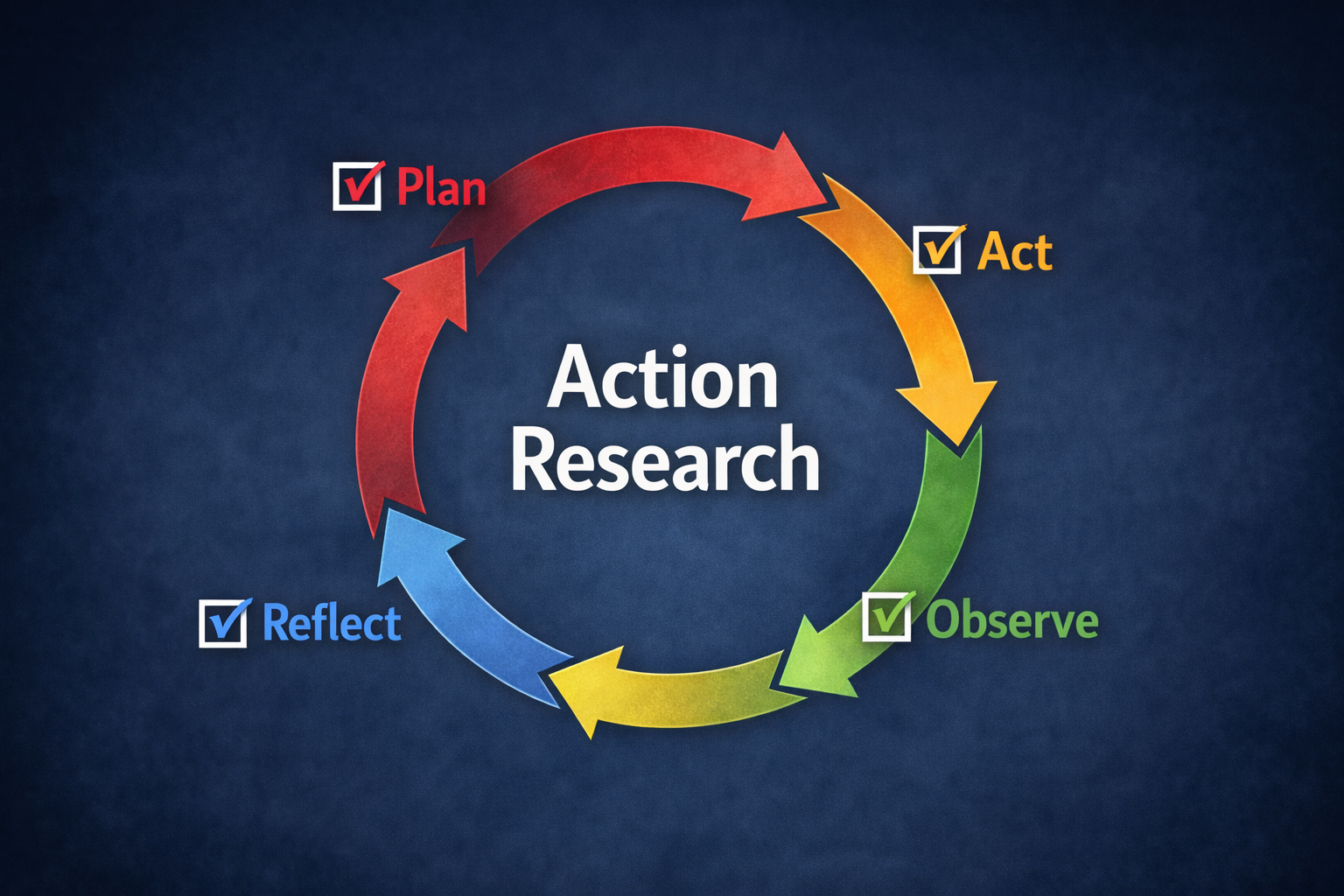
While these insights were drawn from my colleagues, they also resonated with my own research history, which began with my PgCert in Learning and Teaching in 2011. The PgCert was fantastic, and it provided me with an understanding of research conventions, methodologies, and language. It also introduced me to an accessible, attainable model of research that I still think is ideally suited to technicians: action research.
Action research is not generally performative scholarship. Rather, it is a practical, local, ethical, reflective, cyclical, and change-oriented methodology. I was influenced by Lin Norton’s writing, which provided me with an accessible way to complete my first research project and helped me think methodically about improving my own practice. Norton set out a six-step ITDEMS framework:
Step 1: Identifying a problem/paradox/issue/difficulty
Step 2: Thinking of ways to tackle the problem
Step 3: Doing it (implementation)
Step 4: Evaluating it (data collection/analysis/findings)
Step 5: Modifying future practice
Step 6: Sharing your findings
The ITDEMS framework provides a credible and legitimate research methodology for a small-scale investigation that can lead to new insights being effectively shared. Accordingly, pedagogical action research offers the dual benefit of improving practice while also contributing to knowledge.
A practical example from my own work
In my case, the ‘problem’ (step 1) arose after a near-miss on a student film set. The subsequent health and safety investigation I led (step 2) found serious risks arising from poorly communicated processes, unclear ownership, and inadequate stakeholder engagement around risk assessment. This problem became the basis for my PgCert action research project, which I framed around the question: ‘In what ways could redesigning the film risk assessment process improve stakeholder engagement?’
The intervention (step 3) involved redesigning the documents, workflows, and approval routes, changing teaching approaches to reframe safety as professional practice rather than bureaucratic box-ticking, and creating fit-for-purpose approval processes that drew on internal evidence, external benchmarking, best-practice learning from other universities, and stakeholder input from students, academic staff, and professional services teams. I also reached out into the world of professional practice, visiting commercial studios to ensure that the practices taught at university were representative of the professions graduates would enter.
The impact was measurable in both qualitative and quantitative ways, by comparing the prevalence, quality, and level of engagement with the health and safety elements before and after the research (step 4). After presenting the findings to relevant courses and stakeholder groups, feedback was incorporated, and the revised materials were adopted for everyday use (step 5). Subsequently, I was invited to speak about the process at formal forums, including the University Health and Safety Committee, and to present how these changes were pedagogical rather than simply practical at the university learning and teaching conference (step 6).
A key reflection on my action research experience is that I was able to work through the ITDEMS framework and conduct real, valuable, and impactful research that improved my knowledge, experience, and understanding, and positively impacted a range of stakeholders. The project illustrated that impactful research could be generated by technical staff, within the boundaries of everyday work (albeit having to work through some lunch hours and get permission to conduct several site visits, at negligible financial cost: essentially a couple of mileage claims), and still create institutional value.
Additionally, my action research provided me with the tools and confidence to engage in research at a deeper level, opening the doors to a range of more sophisticated and complex outputs, including publishing in journals and books, presenting at conferences, engaging with knowledge exchange, authoring multi-million pound grant funding bids, undertaking additional research-focused qualifications, and being invited to contribute to national policy in the UK and internationally. None of it would have been possible without the first steps into research that action research provided.
This is happening across the sector
I have also seen good work emerging in this space across the sector. While writing this blog I noticed a post from Alexandra Coates, a technician at Northumbria University, in which she identified that some technical spaces could feel unwelcoming or inaccessible, she reflected upon ways they could be made more inclusive, designed an intervention (which included bidding for, and winning internal EDI funding), implemented it, then collected and analysed data to evaluate the impact, and shared the findings, before beginning another cycle (back to (step 1). The initiative had not initially been framed as action research, but it clearly fits the model and offers another example of impactful technician-led research, of which there are many, but infrequently named as such.
Action research as a pathway to recognition and progression
A further benefit was that my action research formed one of the case studies that I used in my application for Advance HE Senior Fellowship (SFHEA). Fellowship requires applicants to articulate what they do, why they do it, what changed, and what impact it had. That reflective process can be strengthened enormously through action research because it provides staff with evidence, language, and structure. At SFHEA level, applicants are required to demonstrate how they lead and influence the learning and teaching practices of others. Some technicians struggle with this, but a well-executed, well-articulated action research project provides powerful evidence. Indeed, Norton explicitly shows how action research can support Fellowship applications, and I have seen the same in my own work with technicians: once people begin to investigate their own practice systematically, it can help shake off imposter syndrome and become more confident and credible in claiming their educational contribution.
Change one thing…
Accordingly, when I started my own business as a consultant and trainer helping universities build and develop technical teams, I wanted to create a professional development course that shared how powerful action research can be for technical and professional services teams. I’ve called it ‘Change One Thing’, and it walks attendees through the methodology while providing reflective models and toolsets that enable non-academic staff to plan, execute, and share impactful research.
Details of the course are on my website. Participants leave being able to:
- reflect on their own professional context to identify an area of practice for meaningful improvement;
- use the ITDEMS model to structure and undertake a small-scale, practice-based intervention;
- gather evidence and evaluate the effectiveness of their change;
- articulate the rationale, process, and impact of their intervention with clarity and confidence;
- recognise how reflective practice contributes to professional growth, student outcomes, and positive educational culture.
What institutions should do next
Of course, there is a critical point at play for institutions as well. Too much good research is still being done in the margins, in people’s spare time, and through goodwill alone. To establish a truly inclusive research culture, universities need more than rhetoric. They need clear routes, ethical guidance, managerially credible approval processes, reasonable access to funding and backfill, support with writing and dissemination, and fair attribution. Technician Commitment action planning and REF 2029, between them, are pushing the sector in that direction, but if my experience is representative, local cultures still have some catching up to do.
Technicians are often at the vanguard of their disciplines, intrinsically curious people who push the frontiers of possibility and knowledge. In the arts specifically, a sizable proportion of research is practical, and technical staff are often among the most capable practitioners within their institutions. In terms of pedagogic research, creative arts technicians have the highest levels of teaching qualifications in the sector. Accordingly, as REF directs us, we should stop seeing research (disciplinary or pedagogic) as an exclusively academic or elite endeavour; it doesn’t require a doctorate, outputs don’t have to be written in scholarly conventions or in support of a funding grant. Very often, as in my case, the first step can be quite small, but transformative: identify one thing that matters, investigate it thoroughly, change it, evaluate it, and share what you learn. That is action research, and in my experience, it is one of the most credible and empowering ways into research that I know.
If you wish to comment on this blog post, please add your thoughts to the original LinkedIn thread. Available here: https://www.linkedin.com/posts/dr-tim-savage-pfhea-b968782b_highereducation-technicians-professionalservices-share-7449743117303447552-yego?utm_source=share&utm_medium=member_desktop&rcm=ACoAAAZbg6IBl-9AP3wGw-BmopG_SAtGrQW1h_U